It’s a frustratingly common pairing: pain in your lower back that seems to have a friend in your hip. They often show up together, feeling like an inseparable duo that can really get in the way of life. The reason they're such a tag team is that your hips and lower back are physically connected; a problem in one area forces the other to work overtime, often kicking off a vicious cycle of discomfort.
Getting your head around this connection is the absolute first step toward finding some real, lasting relief.
Why Your Back and Hip Pain Are So Connected
Think of your body like a well-built house for a moment. Your pelvis and hips are the foundation, and your spine is the main structure rising up from it. If that foundation is a bit wonky—maybe it's tilted, unstable, or stiff—the entire structure above it has to shift and adapt just to stay upright. This simple picture perfectly explains why your back and hip pain are so often two sides of the same coin.
When one hip is tight or a bit weak, it can throw your whole posture and the way you walk out of kilter. You might start favouring one side without even realising it, causing your pelvis to tilt. That imbalance travels straight up the chain to your lower back, putting uneven strain on the muscles, ligaments, and joints there. Day after day, this constant compensation leads to fatigue, inflammation, and that nagging, persistent ache.
The Domino Effect of Dysfunction
It’s not a one-way street, either. A problem starting in your lower back, like a bulging disc or a simple muscle strain, can send pain signals radiating deep into your hip or buttock. This is especially true when nerves that travel from the spine down into the legs get involved.
Take the sciatic nerve, for example. It's the longest nerve in your body, starting in the lower back and running right through the buttock and down the leg. If it gets irritated or pinched, it can fire off symptoms that feel exactly like a hip problem. It can be useful to learn about different ways to handle this type of discomfort; exploring some natural remedies for nerve pain can give you a better grasp of the options out there.
The key takeaway is this: your lower back and hips are partners in every single move you make. When one isn't pulling its weight, the other has to pick up the slack, eventually leading to breakdown and pain.
Setting the Stage for Relief
Understanding this crucial link is genuinely empowering. It shifts the focus from just chasing the spot that hurts the most to looking at the bigger picture. It means real relief involves treating the entire system, not just the symptom.
Throughout this guide, we’ll dig into the specific causes of this shared discomfort and give you practical strategies to get things back in balance.
We’ll cover:
- Identifying the Root Cause: How to figure out if the problem starts in your back, your hips, or both.
- Practical Self-Care: Simple, actionable exercises and lifestyle tweaks to build strength and get more flexible.
- Professional Guidance: Knowing the red flags that mean it's time to have a chat with a GP or physiotherapist here in the UK.
By untangling this connection, you can move beyond just managing the pain and start addressing the real, underlying issue. That’s the path to more effective and lasting relief.
Finding The Root Cause Of Your Discomfort
Pinpointing why you’re in pain is the first real step towards feeling better. Guesswork only gets you so far; when you understand the type of problem you're facing, you can start to tackle it head-on. Most cases of combined back and hip pain fall into one of three buckets: mechanical issues, wear and tear, or inflammatory problems.
Think of it like a problem with a car. Is it a wiring fault, a worn-out tyre, or an engine management system that's gone haywire? Each one needs a completely different fix.
Mechanical Issues: The Wiring Problems
Mechanical problems are all about how the moving parts of your back and hips work together—or, more often, how they don't. When something is out of alignment, stuck, or pinching something it shouldn’t be, it sets off a painful chain reaction.
The most famous example is sciatica. Imagine the sciatic nerve as a long electrical cable running from your lower back, through your bum, and down your leg. If a bulging disc or a tight muscle (often the piriformis muscle deep in your glutes) pinches this cable, it sends out faulty signals. The result is often a sharp, shooting, or burning pain that can travel right from your back, through your hip, and down your leg.
Other common mechanical culprits include:
- Sacroiliac (SI) Joint Dysfunction: This is where the joint connecting your spine to your pelvis gets either too stiff or too loose. It usually causes a deep, nagging ache in the low back and buttock.
- Muscle Imbalances: If you sit for long periods, some muscles like your hip flexors can become incredibly tight, while others like your glutes get weak and lazy. This imbalance can physically pull your pelvis out of its ideal position, putting a constant strain on your lower back.
The diagram below shows just how directly hip instability—often a mechanical issue—can lead to back pain.
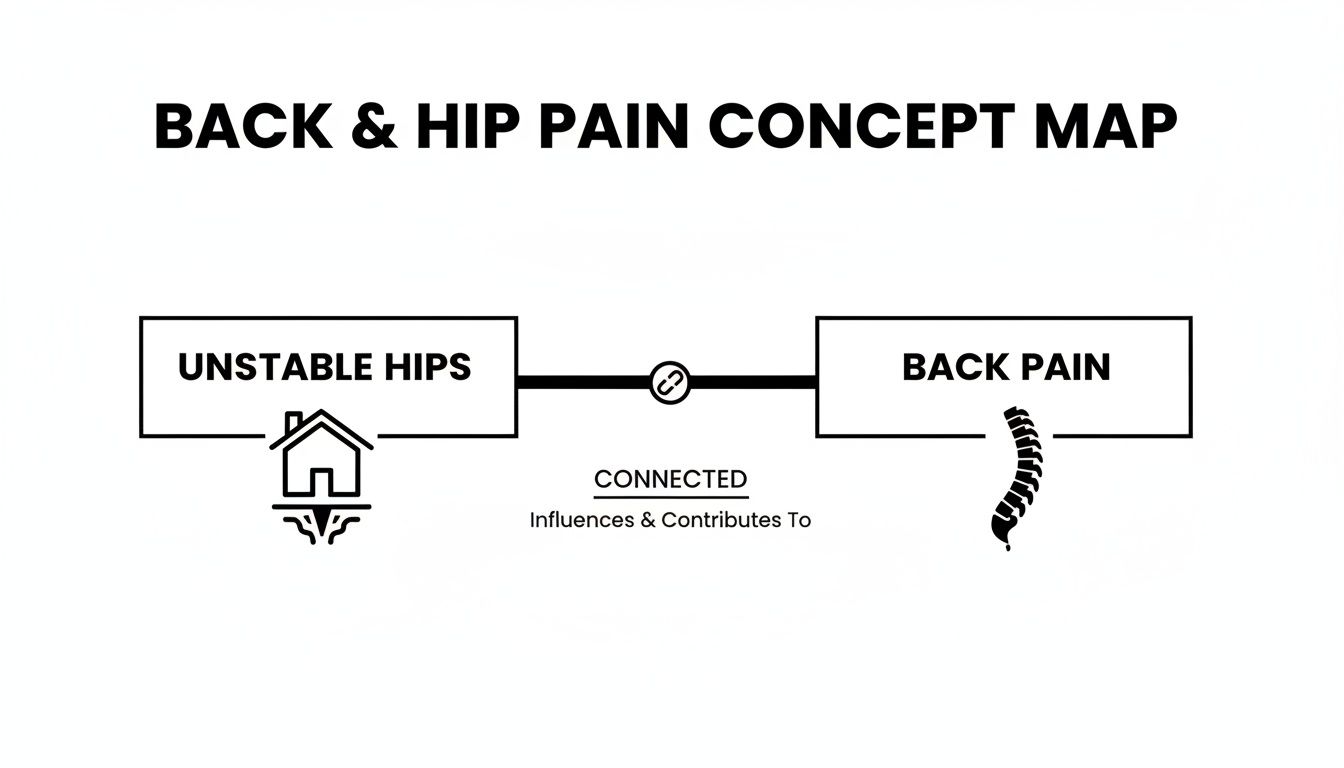
It’s a simple but powerful idea: like a house with shaky foundations, an unstable hip transfers all that stress right up to the structure it’s supposed to be supporting—your spine.
Wear And Tear Conditions: The Worn-Out Parts
Over time, the structures that cushion and support our joints can simply begin to wear down. This isn’t about a sudden fault; it’s the cumulative effect of years of movement. It's a bit like the tread on a car tyre slowly thinning with every mile driven.
Osteoarthritis is the classic example here. It’s often called "wear-and-tear" arthritis for good reason—the protective cartilage that caps the ends of your bones gradually deteriorates. When this happens in the hip joint or the small facet joints of the spine, bone can start to rub directly on bone. This causes a deep, aching pain and significant stiffness, especially first thing in the morning.
And it's incredibly common. Hip and back stiffness are intertwined issues in the UK, with 16% of adults experiencing hip stiffness. This number jumps to 21% among baby boomers. At the same time, 19% report back stiffness that hangs around after a night's sleep or a period of inactivity. This adds up to daily struggles for over 3 million people with related joint problems, as detailed in a comprehensive AXA Health report.
Inflammatory Problems: The System Malfunctions
Finally, some back and hip pain is caused by inflammatory conditions. In these cases, it's not a mechanical issue or simple wear and tear. Instead, the body's own immune system mistakenly attacks healthy tissues, including the joints, causing persistent inflammation.
Conditions like ankylosing spondylitis and rheumatoid arthritis fall into this category. The pain they cause is often inflammatory in nature, which means it can actually feel worse with rest and better with gentle movement. It’s frequently accompanied by profound stiffness when you wake up, often lasting for more than 30 minutes. Learning to recognise the signs of chronic inflammation can be helpful in figuring out if this is what you're dealing with.
Knowing the difference between these causes is crucial. Mechanical pain might respond brilliantly to targeted exercises and posture correction, whereas inflammatory pain often needs medical management to calm down the underlying immune response.
To give you a clearer picture, the table below breaks down the typical patterns for each condition. Think of it as a starting guide to help you have a more informed conversation with your GP or physiotherapist.
Common Causes of Back and Hip Pain and Their Symptoms
| Condition | Primary Pain Location | Key Symptoms | What Makes It Worse? |
|---|---|---|---|
| Sciatica | Lower back, buttock, radiating down one leg | Sharp, shooting, or burning pain; numbness or tingling | Sitting for long periods, coughing, or sneezing |
| Osteoarthritis | Deep in the hip joint (groin) or lower back | Deep, aching pain; significant stiffness in the morning | Inactivity (stiffness), but excessive activity (pain) |
| SI Joint Dysfunction | One side of the low back or deep in the buttock | A dull ache that can become sharp with certain movements | Standing up from a chair, climbing stairs, rolling in bed |
| Inflammatory Arthritis | Both sides of the lower back and hips | Persistent aching and severe morning stiffness | Long periods of rest or inactivity (like sleeping) |
By checking your own experience against these patterns, you can move from just feeling the pain to actually understanding its story. And that knowledge is your most powerful tool for finding the right path to relief.
Practical Self-Care Strategies for Lasting Relief
Knowing what might be causing your back and hip pain is the first step, but now for the practical part. Getting a handle on your discomfort often starts at home with a few consistent, gentle, and strategic actions. This isn't about gritting your teeth and pushing through the pain; it's about building a stronger, more resilient support system for your spine and pelvis.
The goal here is to give you safe, effective steps you can start today. By focusing on smart movement, a few lifestyle tweaks, and supportive therapies, you can create an environment where your body can begin to heal and find real relief from the aches that disrupt your life. This is especially important here in the UK, where the scale of chronic pain is massive.
Over 9.5 million adults in the UK live with persistent pain, and back pain is the single biggest cause of disability. It's a huge issue, responsible for 10% of all years lived with disability and hitting one in five midlife adults again and again. This really underlines the need for accessible, effective self-care, a topic explored in detail in this report on the state of musculoskeletal health.
Building Your Foundation With Movement
When you’re in pain, the very idea of exercise can feel like the last thing you want to do. But honestly, the right kind of movement is often the best medicine. You've probably heard the phrase "motion is lotion," and it's particularly true for stiff, aching joints. We're talking about gentle mobility and targeted strengthening.
Think of your core and glute muscles as a natural corset. When they're strong and switched on, they provide solid support for your pelvis and lower back, taking a massive amount of strain off your spine and hip joints. If these muscles are weak, smaller, less suitable muscles have to step in and compensate, which quickly leads to fatigue and pain.
Here are a few foundational exercises to get you started:
- Glute Bridges: Lie on your back, knees bent, feet flat on the floor. Gently squeeze your glutes and lift your hips up until your body makes a straight line from your shoulders to your knees. This is a brilliant way to wake up your glute muscles without stressing your lower back.
- Bird-Dog: Start on all fours. Extend your right arm straight out in front of you and your left leg straight back, keeping your tummy tight and your back flat. It's a great challenge for your stability and strengthens the deep muscles that support your spine.
- Pelvic Tilts: Lie on your back with your knees bent. Gently flatten your lower back against the floor by tightening your abdominal muscles, tilting your pelvis slightly upward. It's a subtle move, but it's incredibly effective for re-engaging your core.
Remember, the aim is gentle activation, not a punishing workout. When you're managing back and hip pain, consistency is far more important than intensity. Begin with just a few repetitions and build up slowly as you feel stronger.
Smart Stretching To Release Tension
While strengthening builds up your support system, stretching helps to release the tension that often fuels the pain. When muscles like your hip flexors and piriformis get tight—which happens all too easily from prolonged sitting—they can pull your pelvis out of alignment and even irritate nearby nerves.
Here are three key stretches to try and work into your daily routine:
- Kneeling Hip Flexor Stretch: Kneel on one knee (pop a cushion under it for comfort) with your other foot forward. Gently push your hips forward until you feel a good stretch in the front of the hip on your kneeling leg.
- Figure-Four Stretch: Lie on your back with your knees bent. Cross one ankle over the opposite knee, making a "figure four" shape. Gently pull the supporting thigh towards your chest until you feel a deep stretch in the glute of the crossed leg.
- Cat-Cow Stretch: Get on your hands and knees. Gently arch your back up towards the ceiling like an angry cat, then slowly let it drop down, lifting your head and tailbone. This is a fantastic way to encourage gentle movement through your entire spine.
Everyday Ergonomics And Habits
How you sit, stand, and lift things throughout the day can either make your pain worse or help ease it. Making a few small tweaks to your daily habits can have a surprisingly big impact.
Start with your workspace. Make sure your chair supports your lower back, your feet are flat on the floor, and your screen is at eye level. If you have a desk job, set a timer to get up and walk around for a few minutes every hour. That simple act stops your hip flexors from getting short and stiff.
When it comes to localised muscle soreness after a long day or a gentle exercise session, topical applications can offer some targeted comfort. If you’re looking for a soothing option to add to your recovery routine, you might be interested in our guide to choosing a high-quality CBD muscle rub that can complement your stretching and strengthening work.
Proper lifting technique is also non-negotiable. Always, always bend at your knees and hips, not from your waist. Keep the object close to your body and engage your core muscles as you stand up. Let your powerful leg muscles do the heavy lifting, not your vulnerable lower back. By weaving these strategies into your life, you're actively taking part in your own recovery, building a body that's better equipped to handle daily demands with less pain.
When You Need to See a Doctor in the UK
While the self-care strategies we’ve talked about are incredibly powerful for most types of back and hip pain, they aren't a stand-in for professional medical advice. Knowing when to put the home remedies aside and pick up the phone to your GP or NHS 111 is absolutely critical for your health and safety.
Some symptoms are what clinicians call ‘red flags’. This is just a way of saying they could point to a more serious underlying issue that needs immediate medical attention. If you experience any of them, don't try to wait it out.
Urgent Red Flag Symptoms
Think of these as non-negotiable signs to act straight away. If you notice any of the following, it’s time to seek urgent medical help.
- Loss of Bladder or Bowel Control: This is the most significant red flag. If you suddenly can’t control your bladder or bowels, or feel like you can't empty them properly, it requires immediate attention.
- Numbness Around Your Groin or Buttocks: Specifically, numbness in the area that would touch a saddle if you were riding a horse (sometimes called 'saddle anaesthesia') is a very serious warning sign.
- Sudden Weakness in Your Legs: If one or both of your legs suddenly feel very weak or clumsy, or you notice your feet are dragging when you walk, you need to get checked out right away.
These particular symptoms can be linked to a rare but serious condition called cauda equina syndrome, which happens when the nerves at the base of the spinal cord get severely compressed. It needs emergency surgery to prevent permanent damage.
It's always better to be safe than sorry. If you experience any of these red flag symptoms, do not wait. Call your GP's out-of-hours service, NHS 111, or go to A&E immediately.
When to Book a Routine GP Appointment
Beyond the urgent red flags, there are other important signs that it's time to book a consultation with your GP. These situations aren't usually emergencies, but they do suggest that home care alone isn't cutting it for your back and hip pain.
Consider making an appointment if your pain:
- Lasts for Several Weeks: If the pain isn’t improving after a few weeks of consistent self-care.
- Gets Progressively Worse: Your discomfort is steadily ramping up over time instead of getting better.
- Disrupts Your Daily Life: The pain is so severe it stops you from working, sleeping, or doing everyday activities.
- Is Accompanied by Other Symptoms: You also have unexplained weight loss, a fever, or just feel generally unwell.
When you see your GP, they’ll ask you a lot of questions about your symptoms, your medical history, and how the pain is affecting you. They'll do a physical examination and, based on what they find, they can recommend the next steps. This might be a referral to a physiotherapist for targeted exercises, suggesting specific pain relief, or in some cases, arranging for scans like an X-ray or MRI to get a clearer picture of what's going on. Taking this step is how you get an accurate diagnosis and a proper treatment plan.
How CBD Can Support Your Wellness Journey
When you're dealing with the daily grind of back and hip pain, it makes perfect sense to look at every possible tool that can offer support. Alongside the usual advice, a lot of people are exploring complementary options to improve their comfort and general wellbeing. This is where broad-spectrum CBD enters the conversation – not as a miracle cure, but as a helpful partner in a bigger wellness plan.
To get why it might help, you need to know about your body's own endocannabinoid system (ECS). Picture it as your internal regulator, always working behind the scenes to keep things stable – a state called homeostasis. It influences everything from mood and sleep right through to how we perceive pain. CBD interacts with this system, helping to support its natural rhythm and encourage a feeling of ease.
This interaction is especially relevant for the kind of nagging discomfort that often comes with back and hip problems. Let's be honest, finding consistent relief is a massive challenge for many. Here in the UK, a staggering 1 in 5 Britons—that's over 11.5 million people—live with chronic back pain. These conditions were behind 28.2 million lost work days in 2023 alone, a figure that really drives home the scale of the issue.
How CBD Fits Into Your Routine
Bringing CBD into your day is all about supporting your body’s ability to recover and cope. It can lend a hand in a few key ways as you work towards moving more freely.
- Supporting Post-Exercise Recovery: After you’ve done your gentle stretches and strengthening exercises, your muscles are bound to feel it. CBD may help soothe this exercise-induced discomfort, supporting your body’s natural repair process and helping you stay on track with your routine.
- Promoting Restorative Sleep: Good quality sleep is absolutely essential for healing. Pain is a notorious sleep thief, but many people use CBD to foster a sense of calm and relaxation, making it easier to get the deep, restorative rest your body desperately needs to repair itself.
- Encouraging Daily Comfort: By giving your ECS a helping hand, CBD can help your body better manage feelings of discomfort. The goal is to make it that bit easier to get through your day with less of a struggle.
By helping you feel more comfortable and better rested, CBD can make it easier to stick with the positive lifestyle changes—like physiotherapy exercises and gentle movement—that are crucial for long-term relief from back and hip pain.
Choosing a High-Quality CBD Product
The CBD market can feel like the Wild West, but finding a product you can trust really just boils down to a few key things: quality, safety, and transparency. At SMOKO, we live by these principles so you can feel confident in what you're getting.
- Source of Hemp: Our CBD comes from organically grown Cannabis sativa L plants from the USA, giving us a pure, high-quality starting point.
- Manufacturing Standards: We're proud to say all our products are made here in the UK, which means they have to meet our strict quality control standards.
- Third-Party Lab Testing: Every single batch is sent off for independent testing. This verifies its purity and confirms that it's THC-free, giving you total peace of mind.
Whether you go for CBD Oils for their flexible dosing or the sheer convenience of CBD Gummies, the best method is the one that slots easily into your daily life. For a deeper dive into using it specifically for back issues, take a look at our guide on how to use CBD oil for chronic back pain. It's all about making an informed choice and adding another reliable tool to your wellness kit.
Your Path Forward to Better Movement and Less Pain
Dealing with stubborn back and hip pain feels more like a marathon than a sprint. What this guide has hopefully shown you is that it's a journey you can navigate. By now, you’ll have a clearer picture of how your hips and spine are intimately connected, often sharing the load when one is under strain. Just grasping that concept is the single biggest step towards taking back control.
The road ahead really boils down to three key ideas. First, you need to understand the 'why' behind your discomfort—is it a mechanical issue, simple wear and tear, or something inflammatory? Second is embracing gentle, consistent self-care. That means making time for those targeted exercises that build up your core and glutes, creating a natural corset of support for your body.
And finally, it's about knowing when to raise your hand and ask for help, and being smart about the wellness aids that can support you. Realising you're seeing red flag symptoms and booking in with your GP or a physio isn't admitting defeat; it's the strongest move you can make.
Your Action Plan for Relief
Let's pull all that information together into a straightforward plan you can actually use. This isn't about finding a magic bullet overnight. It’s about building small, positive habits that stick.
- Become a Detective: Start paying close attention to what sets your pain off. Is it sitting at your desk for too long? A specific way you twist or bend? Pinpointing your triggers is half the battle won, as it lets you adjust how you go about your day.
- Move with Intention: Weave gentle stretches and strengthening moves into your daily rhythm. When it comes to managing back and hip pain, consistency trumps intensity every single time.
- Tweak Your Lifestyle: Think about your posture, how you lift things, and getting up for a quick wander every hour. You’d be amazed at how these tiny adjustments can add up to huge relief over time.
- Look at Supportive Options: Think about how a high-quality, lab-verified CBD product could fit into your routine, perhaps helping you get the restorative sleep you need or supporting your body's recovery after gentle movement.
The real takeaway here is about empowerment. You're not powerless against this pain. You have a whole toolbox of strategies you can use to manage your discomfort, get moving more freely, and genuinely improve your quality of life.
By taking this proactive approach—getting to know your body, sticking with the right kind of care, and reaching out for expert help when you need it—a life with less pain and more freedom of movement isn't just a pipedream. It’s a goal you can work towards, one small, steady step at a time.
Frequently Asked Questions
When you're trying to figure out back and hip pain, it’s easy to feel like you're drowning in questions. Getting clear, straightforward answers is the first step to feeling more in control of your recovery. Let's tackle some of the most common queries we hear.
Can Stretching Make My Back and Hip Pain Worse?
It’s a great question, and the answer is yes, sometimes it absolutely can. While gentle movement is usually a good thing, stretching isn't a cure-all.
If your pain is coming from an angry nerve (think sciatica from a bulging disc) or an unstable joint, aggressive stretching can be like poking a sleeping bear. You could end up irritating the nerve even more or overstretching ligaments that are already too loose.
The golden rule here is to listen to your body. A good stretch should feel like a mild, relieving pull—never sharp or agonising. If you feel any shooting pains or the ache starts getting worse, stop immediately. It’s often much smarter to start with gentle mobility exercises and targeted strengthening before jumping into deep stretches. A good physiotherapist can create a plan that's actually right for your body.
How Can I Tell If My Pain Is Muscular Or From the Joint?
This is a tricky one because muscle and joint pain often feel tangled together. But there are a few clues that can help you start playing detective.
- Muscular Pain: This usually feels more like a dull ache, a general tightness, or a very specific sore spot. It might flare up after you've been active or if you press directly on the muscle.
- Joint Pain: Pain coming from the hip joint itself is often felt deep in the groin or at the front of the thigh. It tends to be a sharper, deeper kind of ache that gets worse with weight-bearing stuff like walking or climbing stairs. You might also notice a lot of stiffness after you've been sitting for a while.
A simple test can be movement. If the pain is sharpest during a particular range of motion, like trying to bring your knee to your chest, that could point to the joint. If it’s more of a constant, spread-out ache, it might be muscular. Of course, the only way to know for sure is to get a proper diagnosis from a healthcare professional.
Is It Safe to Use CBD for Pain Alongside My Other Medications?
This is a critical question, and the answer is refreshingly simple: you must speak with your GP or a qualified pharmacist before combining CBD with any other medication. This isn't just a suggestion; it's essential for your safety.
CBD can change how your body processes certain drugs. This could mean your medication becomes less effective, too strong, or it could even increase the risk of side effects.
Your GP knows your full medical history and is the only person who can give you personalised advice. Please, never make changes to your treatment plan without talking to them first.
At SMOKO CBD, we're all about a safe, informed approach to wellness. If you and your doctor agree that CBD could be a helpful addition to your plan, we invite you to explore our range of lab-tested CBD products, all made right here in the UK.
Find out more at https://smokocbd.com.